Levi Aurora Forecast: How to Read Kp and Cloud Data
Read the Levi aurora forecast like a local: what Kp, Bz and solar wind mean, which cloud data matters, dark-sky spots near Levi village and how many nights to book.
On this page
Levi sits high in Finnish Lapland, close to 67.8 degrees north, in a band where the aurora oval regularly passes overhead. That latitude is the reason a forecast for Levi is worth reading at all: charged particles funnelled toward the magnetic pole light the sky above Lapland more often than above almost anywhere in Europe. Your job as a traveler is not to find the aurora but to line up three things on the same night — geomagnetic activity, clear sky and darkness. If you want to see how those same readings are interpreted elsewhere in the region, the finnish lapland aurora forecast guide walks through it night by night.
The forecast changes faster than most trip planning does. Solar wind arrives at Earth within roughly half an hour to an hour of passing the monitoring satellite, and the University of Michigan's AuroraTonight app forecasts aurora conditions only about 90 to 120 minutes ahead. Read forecasts as a nightly routine rather than a booking decision, and choose your dates and accommodation for flexibility instead.
Why Levi sits in an active aurora zone
Levi lies in the fell country of western Finnish Lapland, roughly 170 kilometres north of the Arctic Circle. At that latitude the aurora oval — the ring of light around the magnetic pole — is frequently overhead or just to the north, which is why operators here talk about aurora as a recurring winter feature rather than a rarity. Levin Iglut describes Levi as sitting within one of the world's most active aurora zones, where the aurora can appear as often as every other night.
Geomagnetic activity is only one input. Levin Iglut notes that sightings still depend on a dark sky and clear weather, and that summer's midnight sun keeps the sky too bright for aurora. If you want the wider context on viewing spots and accommodation around the resort, the guide to seeing the northern lights in Levi covers the ground beyond the forecast itself.
When the aurora season runs at Levi
Levin Iglut puts the best aurora opportunities on clear, starlit evenings between early September and April, with the resort itself open from late August to early April. During September and October the resort operates Tuesday to Saturday, and from 3 November it opens daily until 13 April. Those dates matter for planning: an early-September visit gives you dark nights but little snow, while a January visit gives you deep winter and short daylight.
The most common viewing hours are between 22:00 and 02:00, when the sky is at its darkest. That window is a planning constraint as much as a fact: it argues for accommodation within a short walk or drive of a dark viewing spot, and against early morning departures the day after a promising forecast.
Levin Iglut also notes that the aurora is often more frequent in autumn and spring than in the depths of midwinter. Midwinter compensates with long, dark days and reliable snow for husky and reindeer activities, while autumn and spring give you a better statistical tilt toward activity but shorter dark hours at the edges of the season.
What the Kp index tells you at Levi's latitude
Kp is a 0-to-9 index of how disturbed Earth's magnetic field is, derived from magnetometer readings around the world. Forecast maps translate a given Kp value into a line showing how far south the aurora oval reaches overhead. At Levi's latitude you are already under or near that oval much of the time, so a modest Kp can still deliver a visible arc low on the northern horizon.
Treat Kp as guidance, not a threshold to wait for. A low Kp on a clear, dark night in Lapland can produce a quiet green band, while a high Kp under cloud produces nothing you can see. Soft Serve News points out that a visible aurora extends further than the overhead line on a Kp map, because the lights can be seen at 45 degrees, 30 degrees or lower on the horizon — but also that light pollution and weather matter more at marginal locations.
Solar wind speed, density and Bz: the signals behind a Kp number
Behind every Kp number are the solar wind's speed, density and the orientation of its magnetic field, measured by a satellite about a million miles from Earth. Typical solar wind travels at roughly 400 kilometres per second, but during geomagnetic storms it can reach 2,000 kilometres per second, compressing Earth's magnetosphere and feeding brighter aurora.
Bz is the up-down component of that magnetic field, and a sustained southward, negative Bz is the signal aurora watchers want: it lets solar wind energy reconnect with Earth's field and enter the magnetosphere. AuroraTonight notes that during geomagnetic storms Bz can reach minus 20 nanotesla or lower for hours, producing large events. A strongly negative Bz in the data is a better reason to set an alarm than a headline Kp figure alone.
You do not need to interpret raw satellite plots to use them. The practical move is to check whether the solar wind is fast, dense and carrying a southward field, then check the local cloud forecast — a promising solar wind reading under an overcast sky changes nothing for your night.
The short warning window: why forecasts change fast
Aurora forecasts are uncertain in the same way weather forecasts are, and substorms can start and stop with little notice. Soft Serve News notes that auroras often arrive with only about 30 minutes of warning, which is why alerts matter more than a forecast read at lunchtime.
The two forecasting approaches have different horizons. NOAA's Ovation model uses the latest solar wind measurement to give roughly a 30-to-60-minute window, while the University of Michigan model uses a time series of solar wind and magnetic observations to forecast 1.5 to 2 hours ahead. Neither removes the need to be awake and outside when conditions line up.
Set up an alert for your location rather than relying on memory. AuroraTonight lets you choose a distance range of about 100 or 200 kilometres, a probability range and a clear-sky threshold, and it can send repeat notifications so a promising night wakes you. A wider clear-sky range alerts you for partly cloudy nights too, which is a reasonable trade-off in Lapland.
Combining the aurora forecast with the cloud forecast each night
Cloud is the input that decides most nights. The aurora forms high in the atmosphere, so any solid cloud between you and the sky cancels the show, and the same forecast pages that show activity also carry cloud data. AuroraTonight pairs the local aurora probability with an hours-of-darkness figure and a clear-sky forecast, which is the combination you actually need.
Make the nightly routine short and repeatable: check the activity and Bz signal, check cloud cover for the next few hours, then decide whether to stay put or drive. If cloud is closing in from the coast or the south, a short drive toward a clearer part of the fell country can rescue a night. Cloud forecasts shift, so recheck before you commit to a long drive.
Weather in Levi also shapes the experience beyond visibility. Clear, cold nights give the sharpest sky, while mild, snowy spells bring the cloud that hides it; that trade-off is normal in Lapland winter and is the reason a fixed one-night aurora booking is a gamble.
Local darkness: light pollution around Levi and where to look north
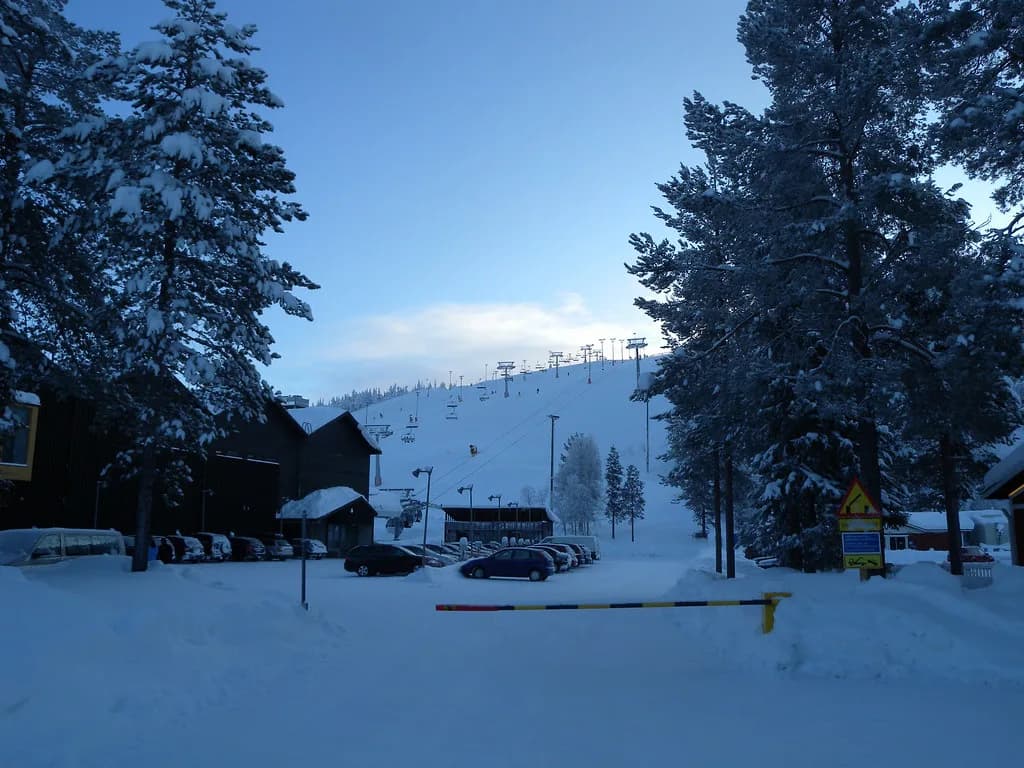
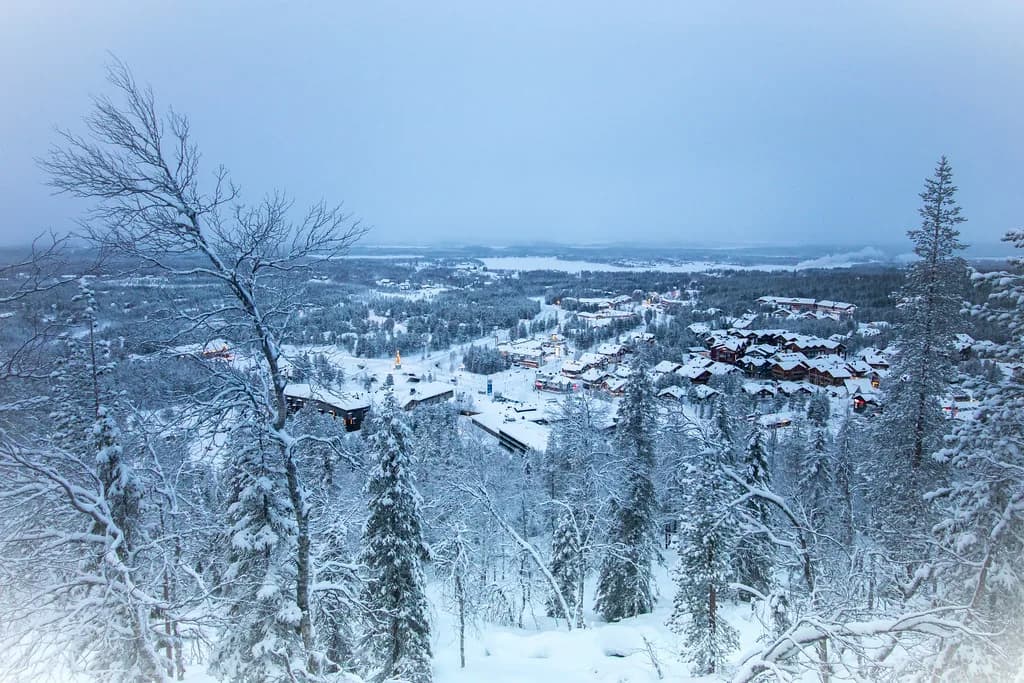
Levi village and the slopes around it produce light that dims faint aurora, and glass igloos and cabin windows add their own glow. Get away from the village lights and let your eyes adjust to the darkness; a full moon brightens the sky and reduces contrast, so darker nights are better for faint displays.
AuroraTonight's darkness map, built on NASA night-light observations, shows how dark the area around a chosen location is, which helps you pick a viewing spot before you drive. Wherever you stop, choose a place with an open northern horizon rather than a clearing ringed by spruce.
There is also a low-tech trick worth knowing: a phone camera in night mode is more sensitive to aurora colours than your eyes, so a photograph of the northern sky can confirm a faint arc you might otherwise miss. Give your eyes time to adapt and avoid checking a bright screen while you wait.
Self-guided chasing versus a guided aurora hunt from Levi
Self-guided chasing gives you control: you read the forecast, pick a dark spot, and drive until the cloud breaks. It suits travelers with a rental car and a few nights to spare, because the strategy depends on being able to move at short notice and to try again the next night.
A guided hunt hands the forecast interpretation and driving to someone who does it nightly, and operators typically run small-group or private trips with pickups from Levi. Levin Iglut works with hand-picked partners offering private and small-group adventures, and arranges private transfers and airport meet-and-greet for guests. Ask an operator directly what happens on a cloudy night, whether the trip is rescheduled, and what clothing is provided.
Whichever route you take, treat a tour as transport and interpretation rather than a guarantee. No operator can move the cloud or the solar wind, and a well-run trip simply puts you in a dark place with a clear view at the right hour.
Glass igloos and aurora cabins: watching from your bed
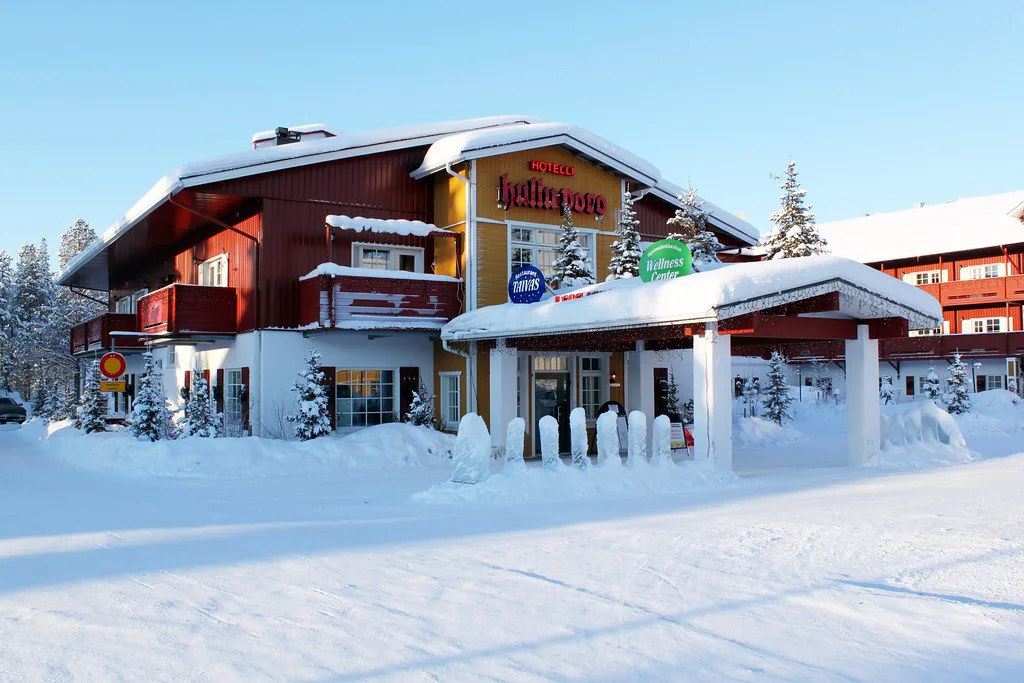
Levin Iglut offers several ways to watch without leaving your room: Superior Igloos with open views to the Arctic sky, Prime Superior Igloos facing either the valley or the forest, a Suite Igloo with a private terrace and jacuzzi, and a Northern Lights House for up to six guests with landscape windows and a hot tub. Breakfast is included in the igloo categories, and Restaurant Utsu serves seasonal dinner menus on site.
The trade-off with glass ceilings is domestic: warm interior air, interior lighting and condensation all work against a crisp view, so keep lights off and expect to step outside for the best look. Compare layouts across the resorts before booking — the guide to glass igloos in Levi sets out the differences — and note that Northern Lights Village Levi offers aurora cabins with a similar watch-from-bed idea.
If you want the full picture of how a cabin-based stay works, from airport transfers to dining, the Northern Lights Village Levi guide sets out what a night there involves. Most guests reach Levi through Kittilä Airport, a short transfer from the village and the fell resorts.
A quieter alternative outside the village is Northern Lights Ranch, which trades the big-resort setting for a smaller property in the fells. It suits travelers who want dark surroundings on the doorstep rather than a drive after dinner.
How many nights to allow for a fair chance of clear skies
Levin Iglut explicitly recommends booking more than one night to give yourself the opportunity to see the aurora from your igloo. That is the sensible rule for any Lapland aurora trip: three or four nights gives you several attempts at the combination of activity and clear sky, and a single night leaves everything to chance.
Spread those nights across the season where you can. Early September offers dark nights before the snow arrives, midwinter brings long nights but more settled cloud patterns, and late March combines longer daylight for daytime activities with nights still dark enough for aurora.
Plan Around the Forecast, Not the Promise
A good Levi aurora forecast is three readings — geomagnetic activity, cloud cover and local darkness — checked on the same night, not a single number saved weeks in advance. Build a trip with several nights, accommodation that lets you step outside quickly, and a plan for either driving to a dark spot or joining a small-group hunt.
Use AuroraTonight or an equivalent alert app for the short-window picture and a Lapland-wide forecast map for context, and keep expectations honest: the aurora is a natural phenomenon and no forecast, app or operator can guarantee a display. For the full picture of where to stay and when to go, start with the northern lights guide for Levi.
Frequently Asked Questions
What Kp do you need to see the northern lights in Levi?
There is no guaranteed threshold. Levi lies far enough north that the aurora oval is often overhead or nearby, so a modest Kp can still produce a visible arc low on the northern horizon. Read Kp alongside solar wind and Bz data, and remember that clear sky and darkness decide whether you see anything at all.
What time of night is best for the aurora in Levi?
The most common viewing hours are between 22:00 and 02:00, when the sky is darkest, according to Levin Iglut. Late evening and early morning darkness generally beats the hours around midnight in terms of competing light, and a full moon reduces contrast.
How accurate is the aurora forecast for Levi?
Short-term forecasts are useful but uncertain. NOAA's model covers roughly 30 to 60 minutes ahead, and the University of Michigan model covers about 1.5 to 2 hours, because aurora substorms can start and stop with as little as 30 minutes of warning. Treat the forecast as a reason to be ready, not a schedule.
Can you see the northern lights from a glass igloo in Levi?
Yes, in the right conditions, and Levin Iglut offers Superior Igloos, Prime Superior Igloos, a Suite Igloo and a Northern Lights House with sky views. Warm glass, condensation and interior lighting reduce the view, so switch lights off and step outside for the clearest look when activity picks up.
How many nights should you stay in Levi for the northern lights?
Book more than one night. Levin Iglut recommends stays longer than a single night so you have more than one opportunity to see the aurora from your igloo, and three or four nights gives you several attempts at combining activity with clear sky.
Is autumn or midwinter better for aurora in Levi?
Levin Iglut notes the aurora is often more frequent in autumn and spring than in the depths of midwinter, while midwinter offers long dark nights and reliable snow. Early September and late March are reasonable compromises, combining dark nights with shorter, more forgiving winter conditions.
Sources
Notes for your Arctic winter trip
Optional updates to our northern lights guides.
You might also like
Continue reading
More guides you'll find useful