Akureyri Aurora Forecast: How to Read Kp and Cloud Data
Learn to read the Akureyri aurora forecast, from Kp and solar wind to cloud cover, and judge which dark, clear nights in north Iceland are worth staying up for.
On this page
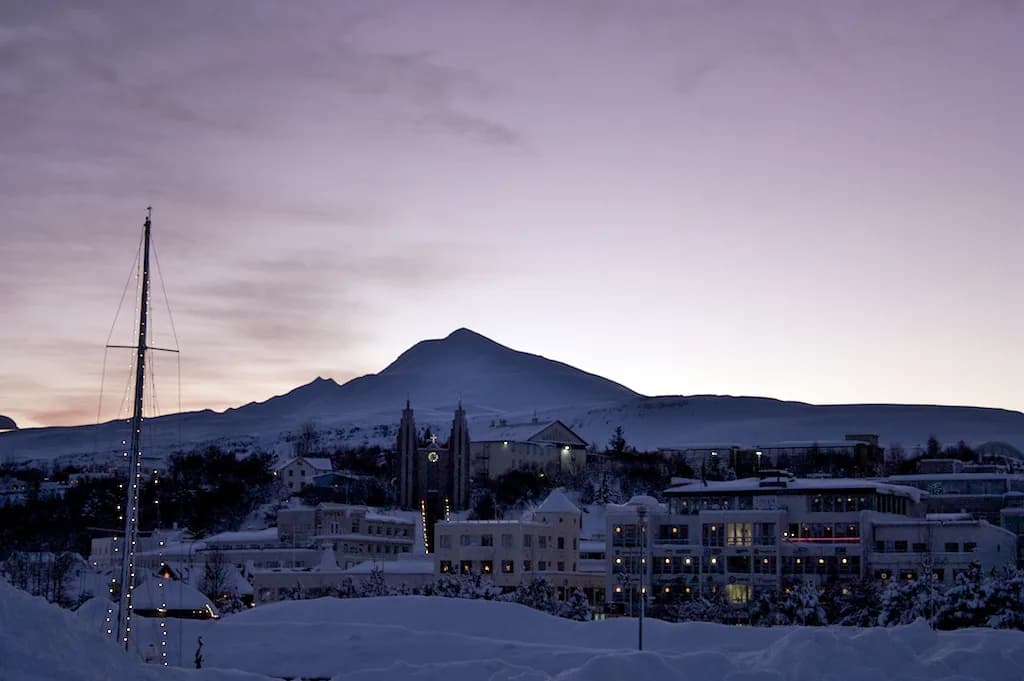
Akureyri gives winter travelers something rare: a compact town at the head of a long fjord, ringed by dark hillsides, with aurora possible on many clear nights of the dark season. You do not need a once-in-a-decade solar storm here, because the town's magnetic latitude sits well inside the auroral oval. What you do need is a clear sky and a way to read the forecast in the right order.
The workable routine is simple: check geomagnetic activity, then check cloud, then pick a dark spot within reach of town. That sequence matters because a strong activity number behind thick cloud delivers nothing, while a modest number over a clear fjord can fill the sky. This guide walks through each signal, the official and third-party forecast tools, and how to turn them into a nightly decision rather than a hope.
Why Akureyri sits inside the auroral zone
Aurora forms in a ring around the magnetic pole, and Akureyri lies close enough to that ring that the lights can appear overhead rather than low on the northern horizon. Forecast services rank Akureyri by magnetic latitude of about 65.5 degrees, placing it in the band where aurora is a regular feature of dark, clear nights. That is the key difference from Reykjavík, which sits farther south and needs stronger activity to see the same display.
Practical consequence: in Akureyri you are rarely waiting for a giant solar storm. You are waiting for darkness and a gap in the cloud, which is why cloud forecasts carry as much weight here as geomagnetic ones. Travelers who plan around the aurora season and accept several nights in town usually have more usable windows than those who book a single night and hope.
If you want the wider context on where the lights appear around the town, the guide to akureyri northern lights sets out the geography of the fjord and the surrounding valleys.
When the aurora season runs in northern Iceland
Aurora needs a dark sky, so the season in the north runs through the months when nights are long. Forecast services describe northern lights as a regular occurrence during dark, clear nights from September through March in Akureyri, and they flag September and March among the better months to plan around.
Midwinter gives you the most hours of darkness per night, with long evenings and short daylight, while the weeks around the equinoxes still offer workable dark hours without the deepest cold. Late autumn and early spring are appealing if you want to combine aurora hunting with daytime excursions such as whale watching or soaking in the Forest Lagoon, Akureyri's geothermal spa north of town.
The trade-off is straightforward: choose midwinter for maximum dark hours, or the shoulder months for more comfortable days and more daylight for sightseeing. Either way, build in several nights, because a single clear evening is never guaranteed in a fjord climate.
What Kp you need at this latitude
The Kp index is a global measure of geomagnetic disturbance on a scale from 0 to 9, and it is guidance rather than a local guarantee. Forecasters calculate a minimum threshold for Akureyri of about Kp 2 for the aurora to become visible, reflecting the town's high magnetic latitude. In practice, quiet nights at Kp 2 to 3 may bring only faint glow, while Kp 3 to 4 gives more defined patterns and Kp 4 or higher can produce strong, colorful displays.
Treat those numbers as a starting threshold, not a promise. A Kp 5 reading during a cloudy night is worthless to you, and a quiet Kp 2 night over a dark fjord can be memorable. The forecast tools that matter most combine Kp with cloud, moon phase, sky darkness and solar wind rather than relying on the index alone.
Higher Kp also widens where the aurora appears, which is useful if you are staying farther south. Northern lights trips based around Reykjavík need stronger activity for overhead displays, so an Akureyri base generally asks less of the solar wind. If you are deciding between the two, the iceland aurora forecast shows how the same Kp reading plays out on the Reykjavík side.
Reading the Icelandic Met Office aurora forecast
The Icelandic Met Office (Veðurstofa Íslands) publishes the official aurora forecast, built around two elements: a cloud cover map and an auroral activity scale of 0 to 9. On the cloud map, green areas indicate cloud and white areas indicate clear skies; you move the slider or click a day and time to see how the cloud is expected to shift. The activity figure is shown for midnight, scaled 0 to 9, and changes with the date you select.
Use the map in two steps. First, find the nearest white or pale patch to Akureyri for the hours you care about; second, cross-check the activity scale in the upper-right box for that date. Timings of sunset, darkness, sunrise and moonrise on that page are calculated for Reykjavík, so use them as a rough reference rather than an exact schedule for the north.
The page also offers separate layers for low, middle and high cloud, which matters in a fjord where low cloud can sit over the town while higher ground stays open. If the composite view looks hopeless, check the individual layers before you give up on the night.
Solar wind and the Bz value in the last hours
Short-term behavior comes down to the solar wind and its magnetic orientation. The Bz value describes whether the interplanetary magnetic field points south, the orientation that couples efficiently with Earth's field; forecast services note that if Bz stays south for a sustained period of roughly 30 minutes, aurora will appear. Solar wind speed, density and total field strength add nuance, with faster wind expanding the auroral oval and higher density supporting more colorful displays.
This explains why a high Kp evening can deliver nothing and a modest one can surprise you. Kp is a summary of past and predicted disturbance, while Bz is the live input. Iceland at Night also publishes all-sky camera feeds and magnetic observatory readings, including measurements from Leirvogur for the past six hours, so you can watch a display build instead of guessing.
For a last-minute decision, read the live signals in this order: Bz first, then solar wind speed, then the all-sky camera nearest you. If the camera shows green structure and the sky above Akureyri is clear, the night is worth the walk or drive out of town.

Combining aurora activity with cloud cover
Cloud is the deciding factor on most nights in north Iceland, and it is also the hardest thing to forecast precisely in a fjord landscape. The Icelandic Met Office presents cloud as a map with a time slider, and green versus white makes the call visual rather than numerical, which is faster than reading percentages.
Third-party services compress the same problem into a single status. AuroraMe, for example, combines Kp, clouds, moon phase, darkness and solar wind into a visibility estimate for Akureyri, and it classifies cloud cover bands so you can see whether 12 percent cloud still leaves a usable sky.
A workable decision loop for each evening: rank the next few nights by activity, check the Met Office cloud map for the hours after dark, then look at a live all-sky camera before committing to a drive. If activity is quiet but the sky is clear, still go out, because quiet nights are the ones when a small surge in Bz can light the fjord overhead.
Local dark-sky spots around Akureyri
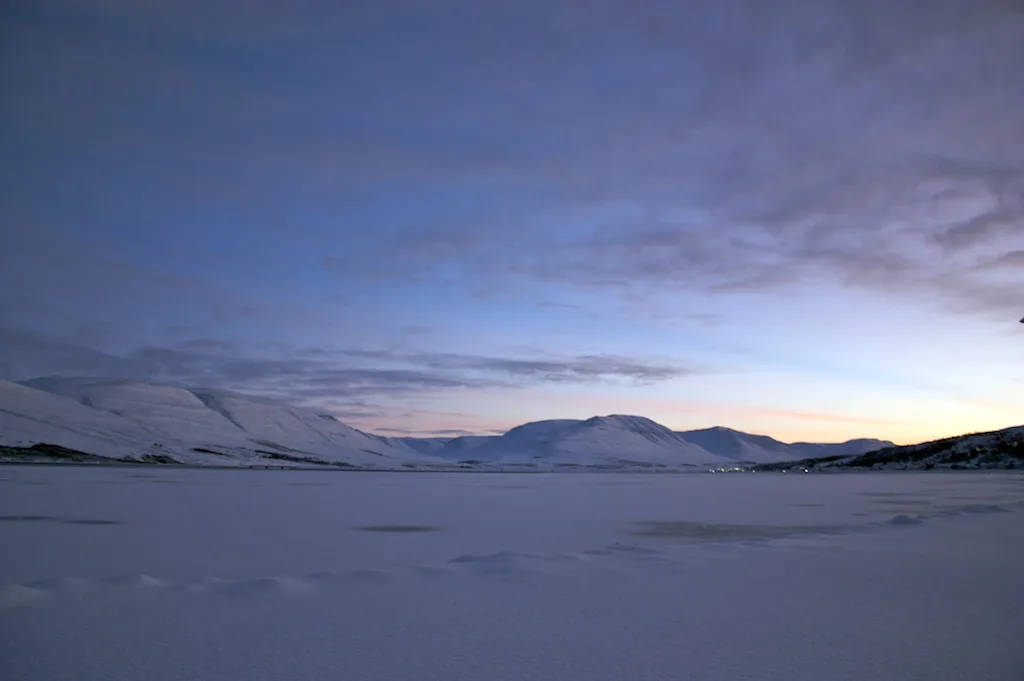
Akureyri is small enough that light pollution falls away quickly, but the surrounding hills and valleys offer cleaner horizons. The fjord's western shore and the roads leading toward the countryside put you away from street lighting within a short drive, and looking north across the water gives an unobstructed view of the traditional aurora band.
For a low-effort evening, the geothermal Forest Lagoon sits on the hillside north of town, where warm water and a dark sky can pair well on a clear night; check its seasonal hours before planning a late visit.
Towns at higher latitudes have their own options: Húsavík, on the coast east of Akureyri, offers GeoSea in Húsavík, a seaside geothermal bath, plus boat-based whale watching in season. If you are weighing a coastal excursion, GeoSea and the town's whale-watching operators make a sensible add-on to an aurora-focused stay.
Wherever you go, pick a spot with a clear northern horizon, park safely off the road, and avoid shining lights at other people's cameras. A short drive out of town beats a long expedition on a night when cloud may close in at any hour.
Self-guided chasing versus booking a tour
Akureyri is well suited to self-guided aurora watching: the town is compact, the roads out are short, and you can react to the forecast in real time. The trade-off is that you carry the decisions and the drive, and a fjord night can close in fast. Renting a car gives flexibility but puts you on winter roads, so check road conditions with the relevant road authority before heading into the hills.
Tours shift the judgment to a local driver who knows the microclimates and can relocate when cloud builds. Iceland at Night lists small-group options from Akureyri and Reykjavík, including a three-hour northern lights photography tour from Akureyri listed at ISK 24,900, and a private three-hour northern lights photography tour from Akureyri listed at ISK 209,900.
Compare durations, group sizes and whether photos, hot drinks and a free re-run are included before booking. A re-run policy effectively buys you a second attempt if the first night is cloudy, which is often worth more in Akureyri than a marginally lower price. Meeting points and cancellation terms vary between companies, so confirm them with the company you book through.
Tours that combine aurora with stargazing
Some nights deliver more than a faint arc, and photography-focused trips are built around that. Iceland at Night lists a three-hour northern lights photography tour from Akureyri, which suits travelers who want guidance on camera settings and a driver who can chase a clearing.
It also lists a northern lights and stargazing jeep tour described as five hours, with professional photos and a free re-run, and private northern lights photography options from Akureyri. The listed photography tour from Akureyri runs three hours, and the private photography tour runs three hours. Durations and inclusions come from the Iceland at Night listings, so check what is provided and who holds the camera before you book.
Stargazing pairs well with aurora because it keeps you outside and looking up during quiet hours. If solar activity is low, a guided sky tour can still give the evening purpose, and the aurora becomes a bonus rather than the whole plan.
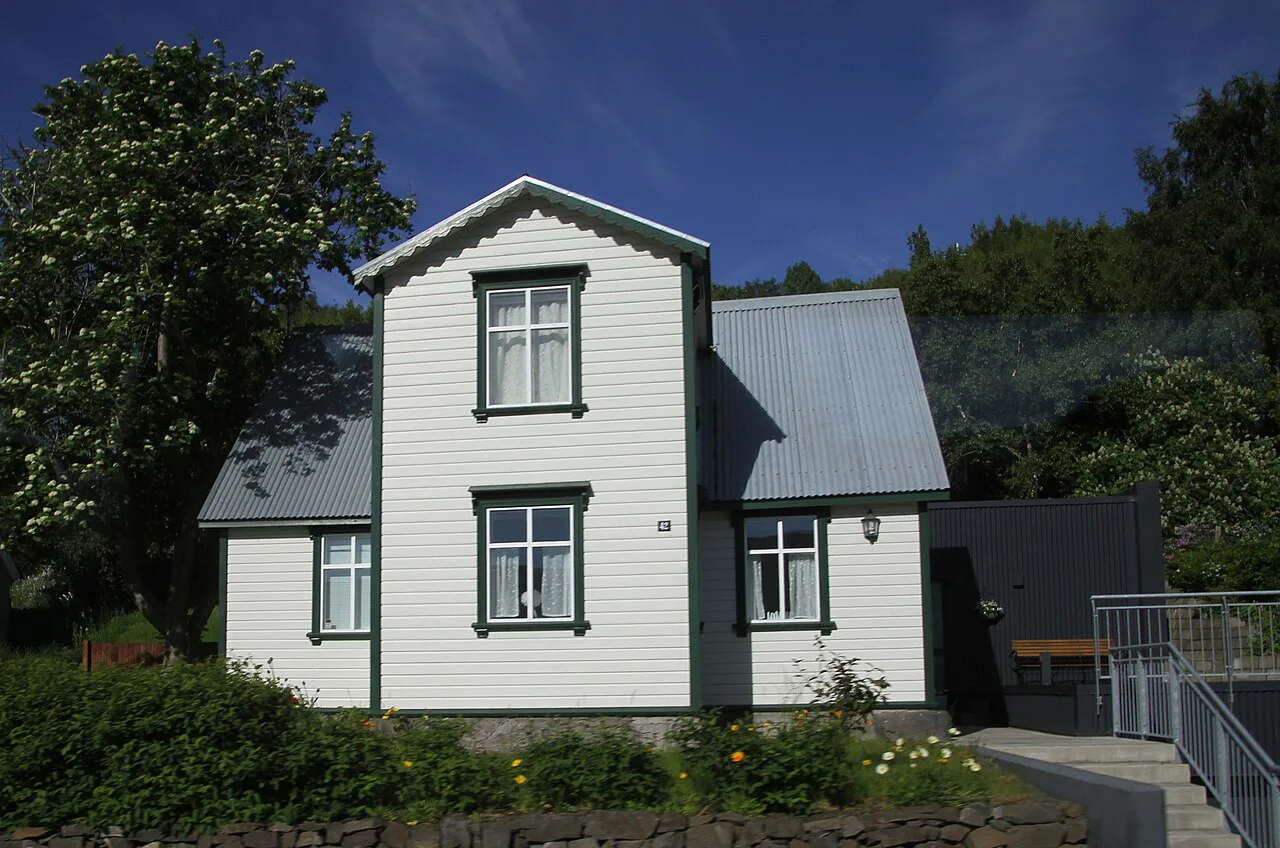
Bright summer nights in the south versus Akureyri's dark winters
Reykjavík and the populated south sit closer to the limits of usable darkness in the shoulder seasons, and summer nights there never get dark enough for aurora. Akureyri, farther north and closer to the auroral oval, trades some of that bright summer for long dark winters that extend the usable window.
This is why the choice of base matters for dates as much as for scenery. If your trip falls in September or March, a northern base such as Akureyri gives you more dark hours per night than the south, and a lower Kp threshold to work with.
Late-season trips still need a plan for daylight: Whale watching and geothermal bathing fill the light hours, while aurora viewing happens late at night. Combining an aurora base in the north with a short stay in the south is a reasonable way to see both sides of Iceland in one trip.
How many nights to plan for clear skies
Nothing guarantees a sighting, because both solar activity and cloud are unpredictable. What you can control is the number of attempts: three to five nights in Akureyri gives you several chances to catch a clear window, while a single night leaves the outcome to luck. Aurora forecast services note that September, October and March are among the better months to plan around, and midwinter offers the longest dark hours.
A fair approach is to book a few nights in town with no fixed itinerary after dark, and to treat each clear evening as a bonus attempt. If one of those nights is booked with a tour that offers a free re-run, you effectively gain another chance at no extra cost.
Using forecast alerts without letting them rule your trip
Alerts and apps are useful for short-term windows, and forecast services send push notifications when conditions line up at a chosen location, sometimes ahead of a real-time display. The Icelandic Met Office also runs a recorded spoken weather forecast by phone, useful when you are out of data coverage.
The risk is turning a holiday into a screen-watching exercise. Set one app, check it a couple of times an evening, and otherwise commit to being outside when the sky is clear, because aurora can brighten and fade within minutes. Your own eyes, a dark horizon and patience outperform any single number.
Keep Kp as guidance, treat Bz and the cloud map as the deciding signals, and accept that some nights will be cloudy. Across several nights in Akureyri, that approach gives you the best realistic chance of a memorable display.
Plan Your Aurora Nights Around the Forecast
Start with the Icelandic Met Office aurora forecast for the cloud map and activity scale, then use Iceland at Night's live solar wind and camera feeds to confirm the evening.
Build in several nights in Akureyri, pick a dark horizon within a short drive of town, and book a tour only if you value a driver who knows the local weather. No forecast guarantees a display, but a clear fjord night at this latitude gives you good odds.
Frequently Asked Questions
Can you see the northern lights from Akureyri?
Yes, Akureyri sits close to the auroral oval, so aurora can appear overhead on dark, clear nights. Magnetic latitude places the town in a band where aurora is a regular feature of the dark season, but cloud can block the view even on active nights. Plan several nights and watch the cloud forecast as closely as the activity number.
What Kp index do you need to see the aurora in Akureyri?
Forecasters calculate a minimum threshold of roughly Kp 2 for Akureyri because of its high magnetic latitude. That is a guide, not a rule: quiet nights may bring only a faint glow, while Kp 4 or higher can produce strong displays. Always pair the Kp figure with a cloud forecast and the live Bz value before deciding to go out.
How do you read the aurora forecast for Akureyri?
Begin with the Icelandic Met Office aurora forecast, which shows cloud cover as a map and auroral activity on a 0 to 9 scale for midnight. Then check live solar wind, especially the Bz value, and an all-sky camera near you. Work in that order: activity first, cloud second, and a dark viewing spot within reach of town last.
How many nights should you plan in Akureyri for the northern lights?
Aim for three to five nights in Akureyri so you have several attempts at a clear window. September, October and March are among the better months to plan around, and midwinter offers the longest dark hours. No forecast can guarantee a display, so treat each clear evening as a bonus chance.
Sources
Notes for your Arctic winter trip
Optional updates to our northern lights guides.
You might also like
Continue reading
More guides you'll find useful