Best Northern Lights App: Forecast, Cloud and Alert Tools Compared
Compare aurora apps for a Lapland or Iceland trip: forecast models, push alerts, cloud layers and free tiers, plus how to read Kp, Bz and the aurora oval.
On this page
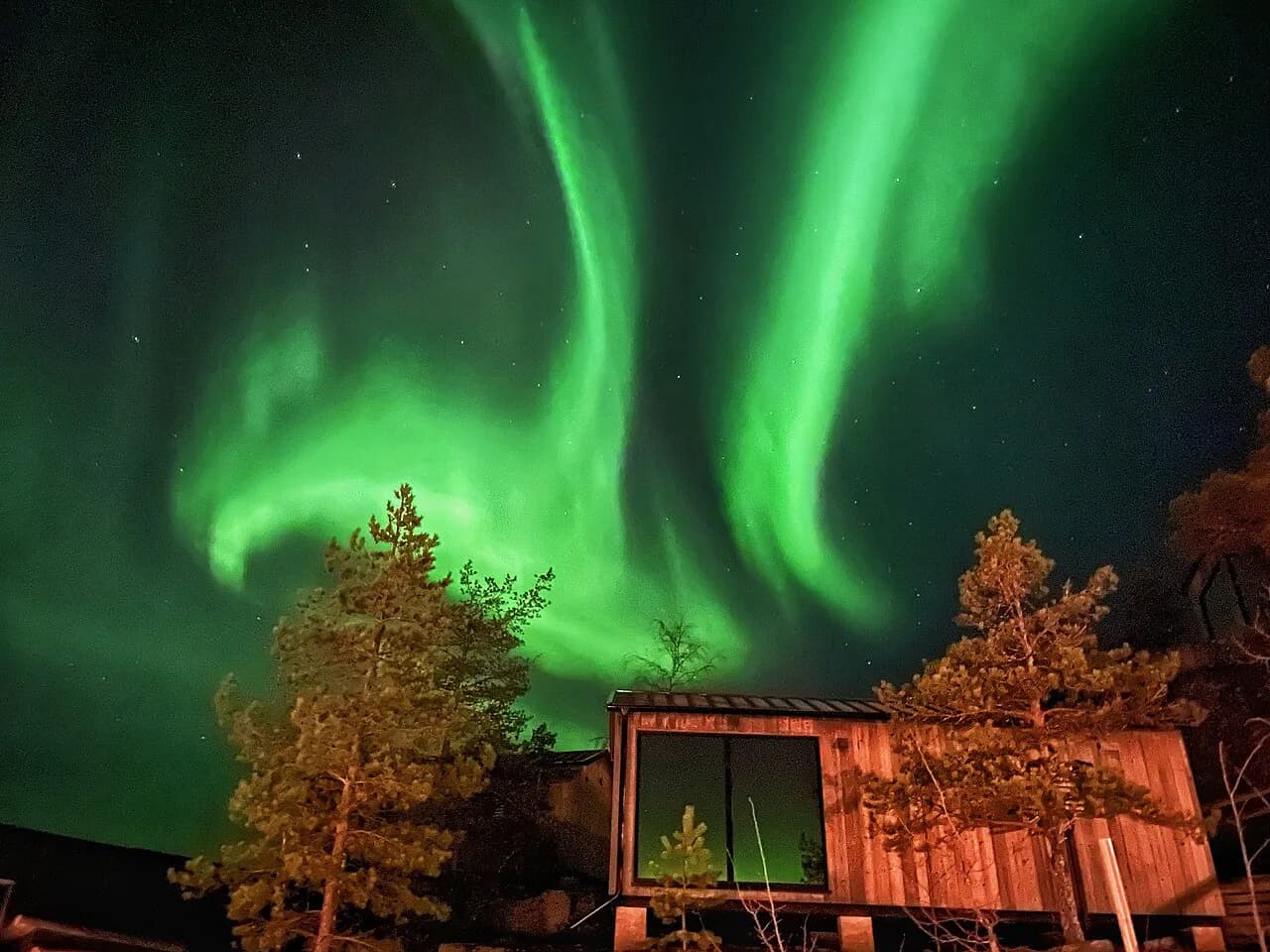
An Arctic winter trip built around the aurora works best when you treat the night as a decision problem: is the sky clear where you are, is activity likely, and is it worth driving, waiting or going to bed. Apps help you answer that quickly, but only if you use one tool for space weather and another for clouds. The choice matters most in Finnish Lapland, Swedish Lapland and Iceland, where a fixed glass-igloo night and a mobile minibus tour demand completely different information.
Plan around the season rather than around a single forecast. Aurora nights in Arctic Europe are dark enough roughly from late August or September into early April, and within that window your realistic forecast horizon is short: solar storms take about three days to travel from Sun to Earth, so beyond that any figure is a guess, as the comparison on AuroraMe explains.
Why one number is never enough: activity, clouds, moonlight and darkness
Most aurora apps lead with the Kp index, a measure of geomagnetic disturbance that rises with solar activity. It is useful guidance and nothing more: a high Kp does not guarantee a visible display, and a low one does not rule one out, especially at high magnetic latitude where the auroral oval sits overhead.
Cloud is the factor that cancels most nights. AuroraMe's comparison argues that 70% of failed aurora sightings are due to clouds, which is why a forecast that shows only Kp tells you very little about whether to leave your cabin. Moonlight and darkness matter too, since a bright moon washes out faint displays and twilight hides them entirely.
The practical consequence is to pair two tools rather than hunt for one perfect app: an activity forecast that also shows your location's magnetic latitude, and a cloud map you can scrub hour by hour. AuroraMe builds Kp, clouds, moon phase, darkness and magnetic latitude into a single go-or-wait verdict, which suits travellers who want one screen instead of three.
How far ahead an aurora forecast can realistically go
Treat anything beyond roughly three days as background noise. Solar wind and storms take about that long to cross from Sun to Earth, so apps showing a 27-day outlook are describing the Sun's rotation and active regions, not the weather you will stand under.
Even inside the three-day window, accuracy is limited: the AuroraMe comparison puts Kp predictions at roughly 80% accurate within three hours, while the same page also markets a 72-hour forecast and a 27-day outlook as planning layers. Use the long view to choose which nights to keep free and the short view to decide when to put boots on.
For a one-week trip, that means committing your accommodation and tour bookings early but leaving the evening decisions late. A guide who watches the same data will often make the call at dinner time and drive an hour or two for a hole in the cloud, which is a better use of the forecast horizon than trying to schedule the perfect night weeks ahead.
Kp versus Bz, density and solar wind speed: what to watch in the field
The Kp index is a summary of disturbance, but the sharper field signals are the Bz component of the interplanetary magnetic field, the density of particles and the speed of the solar wind. Vincent Voyage's guide to aurora data describes a strongly negative Bz as the most promising sign, with density above about 8 and faster winds adding to the display, while a positive Bz usually means calm.
Impressive values can still produce nothing, and modest values can produce a fine display, so use these numbers to decide when to be outside rather than to predict a show. The same guide notes that a Bz near zero can still bring aurora over the far north, which is exactly the range where Finnish Lapland and Swedish Lapland sit.
Apps that combine space weather with local cloud cover
If you want one app that answers whether to go outside now, AuroraMe is the most complete of the options compared in its own guide. It saves any GPS point, combines five factors into a plain-language verdict, and sends predictive alerts 30 to 90 minutes ahead; the free tier covers one location and premium unlocks alerts from multiple locations.
Aurora Labs, built by a professional Arctic guide, takes a similar all-in-one approach aimed at people who would rather follow a guide's workflow than read raw data. Neither app replaces a dedicated cloud map, but both cut down the number of screens you check while standing in the cold.
Pair that with Ventusky for cloud cover, which shows percentage cover hour by hour at kilometre scale and is described as the most accurate cloud tool in the Vincent Voyage round-up, with a paid app and a workable mobile site. Windy is offered as a reliable alternative if you find Ventusky hard to read.
Kp-only alert apps and what they miss
Aurora Alerts has the longest track record, running since 2012 with a simple Kp-focused interface and community features, but it does not fold in cloud cover or moon phase, and its city coverage is narrower than the newer tools. That makes it a reasonable backup alert and a weak primary tool for a mobile trip.
My Aurora Forecast, by contrast, is praised for its notifications: when stronger data arrives you get a ping that typically means something may happen within 30 to 60 minutes, and it arrives as an app or a free web page. Alerts can also stay silent through real displays, so treat a notification as a reason to look up, not a promise.
A Kp-only alert is least useful in a fixed location such as a glass igloo, where you cannot drive to clearer sky and the cloud layer matters more than the activity number. It works better on a mobile guided night, where the guide is already tracking Bz and cloud and your phone alert simply confirms it is time to step outside.
Free web options and the NOAA data behind every forecast
Almost every consumer app sits on top of the same NOAA Space Weather Prediction Center feeds, including the planetary K-index and the OVATION aurora model. The NOAA site itself is raw and technical with no location-specific alerts, but it is the authoritative source when you want to see the data behind an app's green oval.
Space Weather Live is the easier read of the same material, with Kp, Bz and storm-time graphs laid out so you can judge a display at a glance, and Vincent Voyage names it as a reference site. My Aurora Forecast's web version is a free alternative if you would rather not install anything, though it offers no push alerts.
None of these tools charges for the underlying data, so nothing stops you running a free activity page, a free cloud site and one paid app side by side for a week. Pay for an app only if you want multiple saved locations or predictive alerts, not because the free data is worse.
Cloud and weather layers for Finnish Lapland, Swedish Lapland and Iceland
Yr, run by the Norwegian meteorological service, gives a quick global overview with clear weather icons, though its map is too coarse to show small gaps in cloud. Use it in the morning to see whether the pattern is promising, then switch to a percentage cloud layer when you need to choose a direction.
In practice, the cloud decision in Finnish Lapland is usually about how far you are willing to drive from your base toward a clearer inland or coastal strip, and in Iceland it is about which side of the island the weather is breaking. Swedish Lapland sits between the two, with the Torne River valley and its ice hotel drawing winter travellers who treat the aurora as one part of the trip.
Check the cloud layer at noon for a broad view and again in the early evening, since Arctic weather shifts quickly and a three-day-old forecast is not worth acting on. If you are staying in a glass igloo or an aurora cabin with a fixed view, the cloud forecast for that single spot matters far more than the Kp number.
Push alerts versus manual checking: how to plan an evening
Choose one alert app and let it do the watching rather than refreshing a forecast every twenty minutes. A predictive alert that fires 30 to 90 minutes ahead gives you time to dress and step outside, while a notification triggered after activity has started often arrives too late for a short display.
If you are on a guided night, tell the guide you are happy to be woken or moved and keep your phone on silent with alerts enabled; many operators lend thermal suits so you can stand outside for long stretches. On a self-guided night, set the alert, check the cloud map once more, and pick a dark viewpoint away from village lights before the display starts.
Reading the aurora oval for your latitude
The green oval on forecast maps marks where aurora is most likely overhead, and its edge sits at different magnetic latitudes depending on activity. In Finnish Lapland and Swedish Lapland you are usually under or near the oval even on quiet nights, which is why low Kp can still deliver a display; in Iceland the oval often sits slightly to the north, so look toward the northern horizon on modest nights.
Use the oval to decide where to face, not just whether to go out. A clear northern horizon is the minimum requirement, and a view that opens to the north, west and east gives you the best chance of catching an arc as it builds.
Webcams and cross-border comparison before you drive
Webcams are the cheapest reality check available: if a camera a few hours away shows a clear sky and activity is rising, the drive is worth considering, and if it shows overcast, stay put. Vincent Voyage recommends them for comparing conditions between regions before committing to a long transfer.
In the far north, a drive of one to two hours can be the difference between a cloud bank and a clear sky, so weigh fuel and sleep against the forecast rather than chasing every alert. On a short trip, two mobile nights and one rest night usually beats three exhausted attempts.
Using apps on a guided tour night versus self-guided chasing
On a guided night, Wild About Lapland has already made the hard decisions: route, cloud escape and timing, and the company is among the Finnish Lapland agencies worth looking at. Your job is to be ready when the guide stops, keep your phone dimmed, and let the guide run the forecast instead of second-guessing the route from the back of the van. Nightly costs and departure times shift by season, so check current prices directly with the company before you go.
Self-guided chasing puts the whole decision on you, which is where a combined activity-and-cloud app earns its place. Book accommodation with a flexible cancellation policy or a second night, keep the car fuelled, and accept that some evenings will end with nothing but a clear sky and a long drive home.
How many nights to allow for a fair chance of clear skies
Give the aurora four to five nights in Finnish Lapland or Swedish Lapland and a similar span in Iceland, so that one or two overcast nights do not decide the trip. If Swedish Lapland is on your shortlist, the northern lights in Swedish Lapland guide covers where and when to go. No app can promise a sighting: displays depend on solar activity and clear skies together, and even a strong forecast can end in cloud.
Spend those nights in different places where you can, mixing a fixed cabin or igloo with a mobile tour, so a cloudy forecast in one spot does not waste the whole stay. Two clear nights out of five is a reasonable outcome to plan around, and anything more is a bonus.
Putting it together: a simple evening routine
Install one activity app with predictive alerts, keep a cloud map bookmarked, and check the pair at noon and again around dinner time. In Finnish Lapland, Swedish Lapland or Iceland, that rhythm tells you whether to stay near your base, drive for a gap in the cloud, or save your energy for tomorrow.
If you would rather not manage the data yourself, book a mobile guided night early in the trip and keep a second flexible night in reserve. Compare the wider destination options, including the ice hotels of the far north, before you fix your base and your dates.
Frequently Asked Questions
What is the best app for the northern lights?
AuroraMe is the most complete single option among the apps compared here, because it combines Kp, cloud cover, moon phase, darkness and magnetic latitude into one verdict and sends predictive alerts 30 to 90 minutes ahead. Most travellers still pair it with a cloud map for a finer view of where the sky is clear.
Do I need a paid aurora app?
No. The free tiers of the main apps cover a single saved location, and the underlying NOAA data is free on the web. Pay only if you want multiple saved locations, predictive alerts, or detailed cloud layers in a dedicated weather app.
Is Kp 7 good for aurora?
A Kp of 7 signals strong geomagnetic disturbance and often pushes the aurora oval far south, but it guarantees nothing overhead and cloud can still block everything. At high magnetic latitude, lower Kp values often produce fine displays, so read Kp alongside Bz, density and the cloud forecast.
How far in advance can aurora be forecast?
Roughly three days is the practical limit, because solar storms take about that long to reach Earth. Longer outlooks describe the Sun's rotation rather than the sky above your cabin, so use them only to choose which nights to keep free.
Why do aurora apps disagree?
They draw on the same NOAA feeds but weigh different factors. Kp-only apps ignore cloud and moonlight, while combined apps add local weather and a darkness window, so their go-or-wait verdicts can differ on the same evening.
Is a Kp-only alert enough in Finnish Lapland?
It is a useful backup but rarely enough on its own, since cloud decides most nights and a fixed igloo or cabin cannot move to clearer sky. Pair the alert with a percentage cloud map for your exact location.
Which weather app shows cloud cover best for Iceland?
Ventusky is the strongest cloud tool in the comparisons here, showing percentage cover hour by hour at fine scale, with Windy as a workable alternative. Yr is better for a quick overview than for pinpointing gaps in cloud.
Sources
Notes for your Arctic winter trip
Optional updates to our northern lights guides.
You might also like
Continue reading
More guides you'll find useful