Kp Index Guide: Decide Your Europe Aurora Chase
The Kp index measures geomagnetic disturbance on a 0 to 9 scale. Learn what each value means for aurora odds in Finnish Lapland, Swedish Lapland and Iceland.
On this page
The aurora is the reward for a cold, dark night spent in the right place at the right time, and the Kp index is one of the most useful numbers you can watch while planning it. It runs from 0 to 9 and describes how disturbed Earth's magnetic field is during a three-hour window, which tells you how far south the auroral oval may push. Understanding what that number does and does not say changes how you choose a base, book a tour and spend your evenings.
What the Kp index actually measures
The K-index quantifies disturbances in the horizontal component of Earth's magnetic field on an integer scale from 0 to 9, where 1 is calm and 5 or more indicates a geomagnetic storm, according to NOAA's Space Weather Prediction Center. The planetary version, Kp, averages standardised readings from 13 geomagnetic observatories located between 44 and 60 degrees northern or southern geomagnetic latitude. Each value covers a three-hour interval.
That averaging matters for anyone heading to Lapland or Iceland. Kp describes a global, planetary disturbance rather than the sky above your cabin, so it is a guide to how far the aurora may extend, not a local visibility score. A quiet reading can still coincide with a bright arc overhead in the far north, and a storm-level reading can leave you staring at cloud.
Why a low Kp can beat a high one on the night
During calm solar wind the aurora may occur only at very high latitudes and appear faint, while sunlight and clouds remain the biggest obstacles to seeing it at all, as the Geophysical Institute explains. That is why a Kp of 2 or 3 over inland Finnish Lapland, well inside the auroral oval and under clear air, can deliver a far better night than a Kp of 6 over a cloud-wrapped coast.
Treat the number as a secondary signal. Darkness and a mostly clear sky come first; the Kp tells you whether a modest display might push overhead where you are, or whether the oval has expanded far enough south to matter at lower latitudes.
Where Finnish Lapland sits against the auroral oval
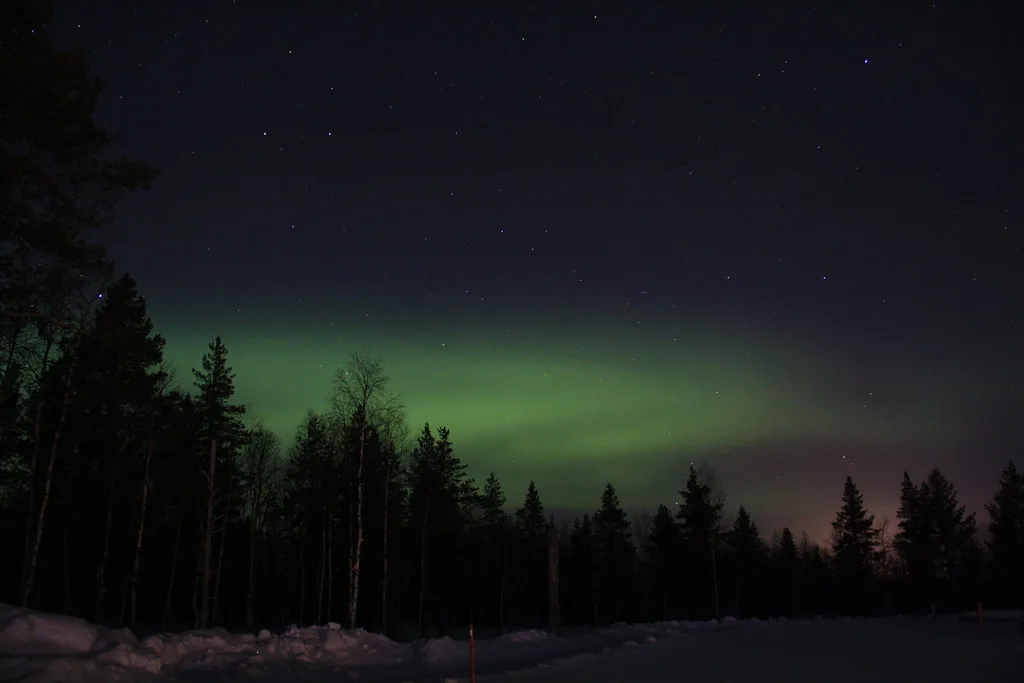
Inland Finnish Lapland lies close enough to the auroral oval that ordinary, moderate activity can put aurora overhead, which is why a low Kp is not a reason to stay in. The practical decision is about geography and weather rather than the number: villages such as Inari, Saariselkä and Levi sit inland, away from the coast, where cold clear nights are more common in midwinter. Among the best places to see northern lights, these inland bases give you room to drive a few kilometres from village lights to a dark lake shore or fell.
On a low-Kp night, prioritise a dark site and patience over a long drive. On a high-Kp night, the same clear inland site may show the aurora high overhead and in colour. Finnish Lapland also offers accommodation designed around the sky, from glass igloos to aurora cabins, and an aurora hotel with a heated glass roof lets you watch from bed without losing warmth, though interior light reduces the view.
Where Swedish Lapland's continental dark skies pay off
Swedish Lapland sits along the same high-latitude band, and its interior is deeply continental: cold, dry and often clear in midwinter. That means your Kp window matters less than whether the sky stays open, so a modest number on a crystal-clear night above the Arctic Circle is worth more than a storm under cloud. Bases around Abisko, Kiruna and the Torne River valley give you dark surroundings and quick access to open viewpoints.
If you are weighing a special stay, the ice hotel tradition along the Torne River is about the setting rather than the forecast, so match the Kp to your nights rather than to your bed. Clear, still, cold evenings inland are the ones to protect: book several nights and treat each clear window as your chance.
Where Iceland's coastal weather changes the calculation
Iceland sits under the auroral oval, and Reykjavík appears among the places that offer a good chance of overhead aurora during average activity in the Geophysical Institute's list. The catch is maritime weather: cloud arriving off the North Atlantic can hide a strong display entirely. In practice the Kp matters less here than a clear gap, and the same Kp of 6 that produces a washout in Reykjavík may be spectacular from a dark farm stay in the north or east. If you are still choosing a base, the northern lights in Iceland guide covers timing and viewing spots in more depth.
Plan around mobility. A car or a guided chase that moves away from the capital's glow toward dark countryside, a lighthouse coast or a rural guesthouse gives you the best response when the forecast number rises but the city sky is overcast. Keep the Kp as a guide only, and judge each evening by the sky you actually have.
How to read a Kp forecast with cloud, moon and darkness
Start with darkness: the aurora is only visible when the sky is dark and at least partly clear, and the best hours are the three or four centred around midnight, with roughly 9 p.m. to 3 a.m. the higher-probability window in interior Alaska winters, according to the Geophysical Institute. The same logic holds in Lapland and Iceland.
Then read cloud, which decides more nights than Kp ever will, and moon phase, since a bright moon adds ambient light that can wash out faint features, although it can also bring out colour. Only last, check the Kp and the short-term aurora forecast to see whether activity is building during your dark window. If you want the background on how the phenomenon works, see what are the northern lights.
Estimated Kp, GFZ quicklook Kp and short-term forecasts
The estimated planetary Kp published by NOAA SWPC is updated frequently and describes the past three hours; it is a measurement of recent disturbance, not a prediction, as SpaceWeatherLive sets out. The GFZ German Research Centre for Geosciences publishes its own quicklook Kp in three-hour steps, expressed in thirds, and an Hp30 index with half-hour resolution that is not capped at 9.
Then there are genuine forecasts. NOAA issues three-day geomagnetic forecasts in three-hour intervals, and the Geophysical Institute displays them alongside a less reliable 27-day outlook and 180 days of observed data. Use the forecast to choose which nights to keep free and the live estimated Kp to understand what is happening now.
The best hours and how a Kp window maps onto your evening
Displays tend to be most rewarding in the hours around midnight and can become more diffuse and fragmented later, so build your evening around a late start rather than an early one. Check when your chosen destination actually reaches full darkness; in midwinter that is early, while in late September or early April you may be waiting until well after dinner.
A Kp window is a three-hour block, so do not read a single high value as a full night of aurora. Watch the trend through the evening: a rising Kp that coincides with clearing skies is the pattern worth staying up for.
Kp and the solar cycle: why activity varies year to year
Geomagnetic activity rises and falls with the solar cycle, and the Geophysical Institute's own FAQ addresses what a solar maximum means for aurora viewing. That is why a quiet week is not a wasted trip: the aurora occurs whether or not Kp is high, and clear skies in the far north can deliver overhead displays at ordinary activity levels.
Book for darkness and a reasonable chance of clear weather rather than for a forecast number months ahead. The best time to see northern lights in Europe runs from roughly late August or September to early April, and within that frame the solar cycle shifts how often storm-level Kp appears, not whether the aurora exists.
How many nights to plan in each destination
Allow at least three or four nights in any one place so weather can move through, and five or more if the aurora is the main purpose of the trip. Inland Finnish and Swedish Lapland offers the best odds of cold, clear midwinter skies, while Iceland rewards a flexible itinerary with a car or a chase-based tour.
Spread your nights across two bases if you can: one inland dark site and, in Iceland, one rural stop away from the capital. That way a cloudy stretch in one region does not use up your whole trip.
Guided tours versus self-guided chasing when Kp is low
A low Kp is no reason to cancel a night out. Guides know the local roads, the dark pull-offs and the microclimates around their base, and a tour moves you toward clearer sky when the forecast is marginal. Self-driving gives you the same freedom to relocate but puts the cloud-reading and night driving on you.
Choose a guide for your first nights in an unfamiliar region and keep a self-drive option for later, especially in Iceland where coastal weather shifts quickly. Treat every operator's night as a chance rather than a promise, since no one can guarantee clearing skies.
Common misreadings of the Kp index
The most common mistake is to treat Kp as a visibility guarantee. A high Kp tells you the magnetic field is disturbed and the oval may expand southward, not that the sky above your hotel will be clear. The second is to treat Kp as a local reading: it is a planetary average, so a low number in Lapland can still be a fine night overhead.
The third is to chase the spike. A brief Kp surge that arrives in daylight, or fades before your evening, does nothing for you, so watch timing as closely as the value. The GFZ Hp30 index, with its half-hour resolution, can help you see whether activity is sustained or just a short burst.
Plan Your Visit
Read the Kp index as guidance only, in this order: darkness, cloud, moon, then the planetary number and its timing. Choose an inland base in Finnish or Swedish Lapland for the clearest midwinter skies, or stay flexible in Iceland and move with the weather. Give yourself several nights, and let the sky decide the rest.
Frequently Asked Questions
What is a good Kp index for seeing the northern lights?
There is no single threshold, because Kp measures global geomagnetic disturbance rather than local sky conditions. In inland Finnish Lapland or Swedish Lapland, well inside the auroral oval, a low Kp on a clear night can still show aurora overhead, while in Iceland a high Kp under cloud shows nothing. Read cloud and darkness first and Kp second, as guidance.
Does a higher Kp index mean I will definitely see the aurora?
No. A high Kp means the magnetic field is more disturbed and the auroral oval may expand farther south, but visibility still depends on a dark, mostly clear sky. Overcast weather, moonlight and town lighting can all hide a strong display. No forecast or operator can guarantee a sighting.
Is the Kp index a forecast or a measurement?
The estimated planetary Kp published by NOAA SWPC reflects the past three hours and is a measurement, not a prediction. Separate three-day geomagnetic forecasts and the GFZ quicklook Kp are useful for planning which nights to keep free. Use the live value to understand current conditions and the forecast to choose nights.
How often is the Kp index updated?
The NOAA estimated planetary Kp is updated very frequently, roughly every minute, as an estimate covering the previous three-hour interval, and it is expressed in three-hour blocks. The GFZ quicklook Kp is also reported in three-hour periods. For planning, the daily-updated three-day geomagnetic forecast is more useful than minute-by-minute changes.
What time of night should I watch for the aurora?
Aim for the hours around midnight, with roughly 9 p.m. to 3 a.m. commonly cited as the higher-probability window in interior northern winters. In midwinter at high latitudes, darkness arrives early, so you can start before midnight. Displays can become more diffuse later, so watch the trend and stay flexible.
Do I need a tour to see the aurora when the Kp is low?
Not necessarily. A low Kp is not a reason to stay in, especially inland in Lapland where the aurora can appear overhead at ordinary activity. Guided chases help in unfamiliar regions or marginal weather because guides know local dark sites and can move toward clear sky. Self-driving offers the same freedom if you are comfortable reading cloud and driving at night.
Sources
Notes for your Arctic winter trip
Optional updates to our northern lights guides.
You might also like
Continue reading
More guides you'll find useful