Where to Stay in Swedish Lapland for the Northern Lights
Compare Abisko, Kiruna, Jukkasjärvi and Björkliden as aurora bases in Swedish Lapland, with the hotels and cabins that suit dark-sky viewing best.
On this page
Swedish Lapland puts you deep inside the auroral oval, the band where overhead aurora is most frequent, and hands you long, dark winter nights to watch it. The choice that shapes your trip is not which hotel has the best view but which base you sleep in: a national-park village with almost no light pollution, a mining town with an airport and restaurants, or a small mountain station close to the Norwegian border. Each trades darkness against convenience in a different way, and the right answer depends on whether you want to chase clear skies yourself or come back to a warm bar after a guided night out.
Why Swedish Lapland works for aurora nights
Aurora appears when charged particles funnelled by the Earth's magnetic field excite gases high in the atmosphere, and the effect concentrates in a ring around the magnetic pole. Northern Sweden sits under that ring, so displays can appear high overhead rather than low on the northern horizon as they do further south. You do not need extreme solar activity to see something here; you need darkness and a hole in the cloud.
The practical season runs from late August or September, when nights in the far north are dark again, through to early April. Midwinter delivers the most hours of darkness but also the shortest days, and cloud cover varies sharply between the mountains and the coast, so inland bases such as Abisko and Kiruna generally give you more usable night hours than the Bothnian coast. Plan around dark nights rather than around a single date.
Treat Kp forecasts as guidance only. A low Kp number can still deliver a bright overhead display in Lapland, while a high one is useless under thick cloud, so the deciding factor on any given night is the local sky rather than the global index.
Abisko: the national-park base for dark skies and self-guided watching
Abisko sits at the edge of Abisko National Park, roughly 100 km west of Kiruna toward the Norwegian border, on the shore of Torneträsk. The surrounding mountains and the park's low development keep light pollution minimal, which is why the village works so well for travellers who want to walk out after dinner and watch on their own rather than join a bus tour.
The classic dark-sky walk is into the national park toward Abiskojåkka, the river gorge that cuts through the park, where open ground and the gorge rim give clear northern horizons within easy reach of the village. On cloudy evenings the mountains can trap cloud against the lake, and the practical move is to watch the sky instead of committing to one spot early.
Abisko is also a base for winter activities beyond the aurora: cross-country ski trails, snowshoe routes and guided tours run from the village through the season. If your priority is the highest ratio of dark hours to effort, this is the strongest base in Swedish Lapland; if you want restaurants, shops and a busy town evening, it is not.
Where to sleep in Abisko: STF Abisko Turiststation and the village
STF Abisko Turiststation is the anchor of the village, a large mountain station with hotel rooms, cabins and hostel-style accommodation, plus a restaurant and activity desk, and it is the most-booked property in Abisko on major booking platforms. Staying here puts the national park trailheads and the dark-sky gorge walk within minutes of your bed, which matters more than room size on an aurora trip.
The alternative is the smaller cluster of cabins and guesthouses around Abisko Östra, the village stop on the railway line, where accommodation is quieter and often closer to open ground. The railway line is itself useful: it links Abisko with Kiruna and with the Norwegian border, so you can build a stay here without a car.
Whichever you pick, book a room with a window that faces open sky or a cabin you can step out of directly, and treat the accommodation as a warm base rather than a viewing platform. Sightings depend on solar activity and clear sky, so a few nights here with flexible daytime plans improves your odds far more than a premium room does.
Kiruna: town convenience, airport access and darker spots outside the centre
Kiruna is the largest town in Swedish Lapland and its practical hub, with the airport, the railway station and the widest choice of hotels, restaurants and tour operators. It sits roughly the same distance from the auroral oval as Abisko, but town lighting cuts into the view from the centre, so staying here means pairing a comfortable hotel with a short drive or a guided tour to reach darker ground.
The town is being relocated building by building because of subsidence from the iron mine, which is why parts of the centre are new and the old clock tower and town hall sit beside recently built blocks. For a traveller this mostly means modern hotel stock and a compact centre you can walk in an evening.
Darker viewing spots lie outside the built-up area, toward the surrounding hills and lakes, and most operators run evening tours that pick up in town and drive to wherever the cloud gap is. That is the main argument for basing in Kiruna: you get an airport, a bed and a guide in one place, and you accept a shorter walkable dark-sky window than in Abisko.
Hotels in and around Kiruna, from Camp Ripan to Elite Hotel Frost and Scandic Kiruna
Camp Ripan is a cabin-style resort on the edge of town with its own restaurant and activities, and it suits travellers who want space, parking and a base that feels more like a lodge than a city hotel. Scandic Kiruna is a central, full-service option close to shops and food, handy if you want to walk to dinner and back.
Elite Hotel Frost is a newer central property with a restaurant, bar, fitness centre and 24-hour reception, and it appears among the most-booked hotels in Kiruna. Best Western Hotel Arctic Eden is another town option, and the nearby supermarket makes self-catering easy for travellers who want to keep evenings free for chasing clear sky.
Outside town, Niehku Mountain Villa near Riksgränsen and Arctic Bath near Harads offer a very different register: small, design-led stays with activities attached, better suited to a short indulgent trip than a multi-night aurora hunt. They are not in Kiruna, so treat them as separate bases rather than town hotels.
Jukkasjärvi and IceHotel: ice rooms, warm rooms and Arctic cabins 16 km from Kiruna
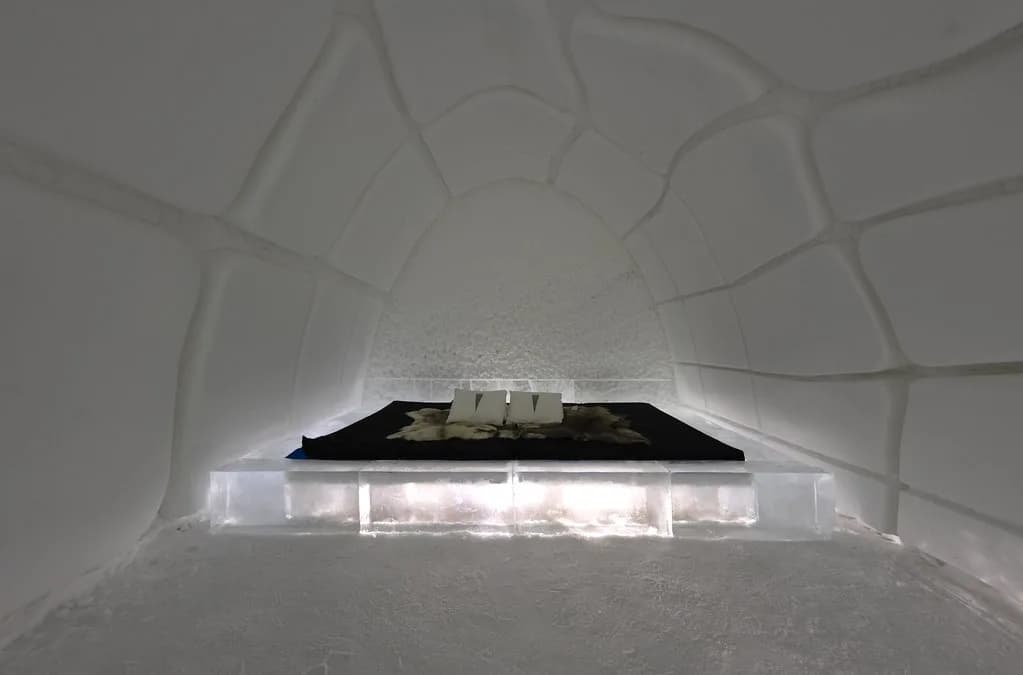
Jukkasjärvi is a small village on the Torne River about 16 km east of Kiruna, and it is home to Icehotel, which builds rooms and suites from river ice each winter alongside warm hotel rooms and Arctic cabins. The village is small and dark enough at night that guests can often step outside and look up, but the ice rooms themselves are a one-night experience rather than a comfortable multi-night base.
The practical arrangement is to sleep in a warm room or cabin for most nights and book the cold ice room as a single night, so you get the experience without spending every night in sub-zero temperatures. Icehotel also runs husky sledding and other winter activities from the village, which fills the short daylight hours before the aurora window opens.
Because Jukkasjärvi is only a short transfer from Kiruna, it works well as a stay-and-tour combination: you get a dark village setting with the airport and town services close by. Guests at Icehotel are among those who report aurora sightings from the property, but sightings depend on clear skies and solar activity, so plan for several nights rather than one.
Björkliden: a small mountain base between Abisko and the Norwegian border
Björkliden lies roughly between Abisko and the Norwegian border, a compact mountain village with a hotel and cabins set against the lake and mountains. It is even quieter than Abisko, with almost no light pollution and open views over Torneträsk, which makes it a strong choice for photographers who want a short walk from the door to a dark horizon.
The trade-off is scale: fewer restaurants and services than Kiruna, and evening options beyond watching the sky are limited, so a car or guided tours are useful for daytime activities. There are two hotels listed in Björkliden, which tells you something about how small the base is compared with the 74 hotels listed in Kiruna.
For travellers who want to combine aurora nights with downhill or cross-country skiing, the mountain setting works well, and the village's position close to the Norwegian border puts you in the same dark-sky corridor as Abisko.
Comparing the bases: darkness versus transfers, dining and things to do on cloudy nights
Abisko and Björkliden win on darkness and walking access to open sky, while Kiruna and Jukkasjärvi win on transfers, dining and things to do when the sky is overcast. If cloudy evenings would leave you with nothing to do in a tiny village, base in Kiruna and take guided tours out; if you would rather wander out at midnight without a plan, base in Abisko, and our guide to where to stay in abisko for the northern lights weighs up the village's properties in more detail.
Dining matters too: Kiruna has the broadest restaurant choice and the easiest self-catering, Jukkasjärvi has Icehotel's restaurants, and the mountain villages are built around their hotel kitchens. For stays longer than a few nights, that difference shapes how well you pace yourself.
Booking platforms list 717 hotels and other places to stay across Lapland Sweden, with 74 in Kiruna, 7 in Abisko and 2 in Björkliden, which gives you a rough sense of how much choice each base offers. Prices vary by season and date, so compare properties for your own dates rather than relying on a headline rate.
Self-guided aurora chasing versus a guided night tour
If you base in Abisko or Björkliden, self-guided watching is straightforward: walk toward the national park or the lake, find open sky, and wait. A guide adds value mainly on cloudy nights, when an operator can drive to a clearing in the cloud that you would struggle to find on your own, and most tours include pickup, transport and thermal suits.
Guided tours typically run in the evening after dark and return after midnight, and some companies offer wake-up calls if the aurora appears while you sleep, which is worth asking about when you book. Group sizes, durations and what is included vary between companies, so read the tour description carefully.
Self-guided chasing is free, flexible and often more rewarding in a dark village, but it depends on your own ability to read the sky and the cloud forecast. A combined approach works well: book one guided night early in your stay so you learn the local geography, then chase on foot for the rest of the trip.
How many nights to plan for a fair chance of clear skies
Cloud is the constraint you cannot control, and a single night gives you one roll of the dice. Three to four nights at one base gives clear skies a reasonable chance without turning the trip into a week of waiting, and travellers who build in a buffer night at the start or end cope better with a cloudy stretch.
A longer stay, not a specific hotel, is what improves your odds: the same sky passes over every property in the village, so extra nights beat an upgrade. Pick a base you are happy to spend a cloudy day in, then give the aurora several nights of chances rather than betting the trip on one.
If you are combining aurora nights with other winter activities, the extra nights also give you something to do in daylight. The wider guide to Swedish Lapland in winter covers how the season shapes activities beyond the aurora.
When the aurora season runs and how daylight changes through winter
The aurora season in Swedish Lapland runs from late August or September, when nights become dark enough, through to early April. Around midwinter the far north has very short days and long nights, which maximises aurora hours but limits daytime activities; by March and early April you get longer daylight and still-dark nights, a balance many travellers prefer.
Cloud cover, snow and temperatures vary through the season and between the mountains and the coast, so build your trip around dark nights rather than around a single date. If you want both aurora and comfortable days, late winter is often the better fit.
The wider guide to the northern lights in Sweden sets out how the season and conditions vary across the region.
Matching the stay to your trip: couples, families and photographers
Couples often do best with a warm cabin or a design-led stay near Kiruna or Jukkasjärvi, where a restaurant and a dark walk from the door both exist. Families benefit from town hotels with breakfast included, such as the Kiruna properties, because short winter days and cold evenings are easier to manage with children when the base is compact.
Photographers should prioritise Abisko, Björkliden or a cabin with open northern horizons, and plan several nights so they can wait for a clear window. Family-friendly properties listed in the region include Arctic Bath and Niehku Mountain Villa, both of which are better suited to a short stay than a long aurora hunt.
For a broader picture of what to do across the region, the northern lights in Sweden guide covers the wider landscape of bases and activities.
Plan Your Visit
Choose your base by how you want to spend a cloudy evening: Abisko and Björkliden for dark skies and walking access, Kiruna for airport convenience and restaurants, and Jukkasjärvi for Icehotel and a short transfer to town. Then give the sky several nights, because sightings depend on solar activity and clear skies rather than on which room you booked.
Book your accommodation for your own dates, confirm transfers and activity pickups with the tour company directly, and keep a flexible night or two free for the clearest forecast. That combination, not a specific hotel, is what gives you a fair chance of a good aurora night.
Frequently Asked Questions
What are the best places to stay in Swedish Lapland for the northern lights?
Abisko and Björkliden suit travellers who want dark skies and short walks to open ground, while Kiruna and Jukkasjärvi suit those who want an airport, restaurants and guided tours close by. The right choice depends on whether you prefer a tiny mountain village or a town base, not on which hotel claims the best aurora view.
Is Abisko or Kiruna better for aurora viewing?
Abisko has minimal light pollution and open dark-sky walks from the village, so it is the stronger base if you want to watch on foot. Kiruna offers airport access, more hotels and restaurants, and guided tours that drive you out of town to darker ground, which suits travellers who want convenience over a short walk.
Can you see the northern lights from IceHotel in Jukkasjärvi?
Jukkasjärvi is a small, dark village on the Torne River about 16 km from Kiruna, so guests can often step outside and look up. Sightings still depend on solar activity and clear skies, so plan several nights rather than expecting a display on any one night.
How many nights should I stay in Swedish Lapland to see the aurora?
Three to four nights at one base gives clear skies a reasonable chance, and a buffer night at the start or end helps if a cloudy stretch arrives. A longer stay, not a more expensive room, is what improves your odds.
Do hotels in Swedish Lapland offer northern lights wake-up calls?
Some operators offer wake-up calls during guided stays, and it is worth asking when you book. Availability varies by property and tour, so check current details with the hotel or operator.
When is the aurora season in Swedish Lapland?
The season runs from late August or September, when nights become dark enough, through to early April. Midwinter gives the most darkness, while late winter balances longer daylight with still-dark nights.
Should I stay in a glass igloo in Swedish Lapland?
Glass igloos are more common in Finnish Lapland than in Swedish Lapland, where the aurora stays tend to be cabins, mountain stations and town hotels. If a glass-roofed room is a priority, compare cabins with large windows in Abisko, Björkliden or around Jukkasjärvi and read what the property actually offers.
Do I need a car to chase the aurora in Swedish Lapland?
A car helps in Björkliden and other small bases where services are limited, while Abisko is walkable for dark-sky viewing and Kiruna has tours with pickup. The railway connects Abisko, Kiruna and the Norwegian border, so a car is not essential if you base in a village or book guided nights.
Sources
Notes for your Arctic winter trip
Optional updates to our northern lights guides.
You might also like

Continue reading
More guides you'll find useful