Polar Night in Europe: Where to Go and How to Plan
Polar night means weeks without sunrise above the Arctic Circle. See where it falls in Lapland and Iceland, how long it lasts and how to plan around it.
On this page
Polar night turns the far north of Europe into a place of twilight middays, starry afternoons and long, dark evenings built for aurora watching. Towns and resort villages inside the Arctic Circle keep the sun below the horizon for weeks at midwinter, and the travel trade fills those weeks with husky sledding, snowmobile runs and aurora chases. It suits travelers who want winter landscape, quiet and dark skies more than bright sightseeing days.
The term gets used loosely, so it helps to separate the strict definition from the season travelers actually book. Strictly, polar night is when the sun stays below the horizon through the whole day, while the wider dark season runs from the first usable autumn nights to the last spring ones. That wider window, roughly late August to early April, is the period when aurora trips run across Finnish Lapland, Swedish Lapland and Iceland. This guide covers both, so you can time a trip to the darkness and the light you want.
What polar night actually means
Polar night is not 24-hour blackness. The scientific definition is simply that the sun stays below the horizon across the entire day, never rising at all, which is a matter of solar elevation rather than a total absence of light. In practice the sky still passes through twilight, deep blue and pastel colour around midday, and stars can be visible in the middle of the day.
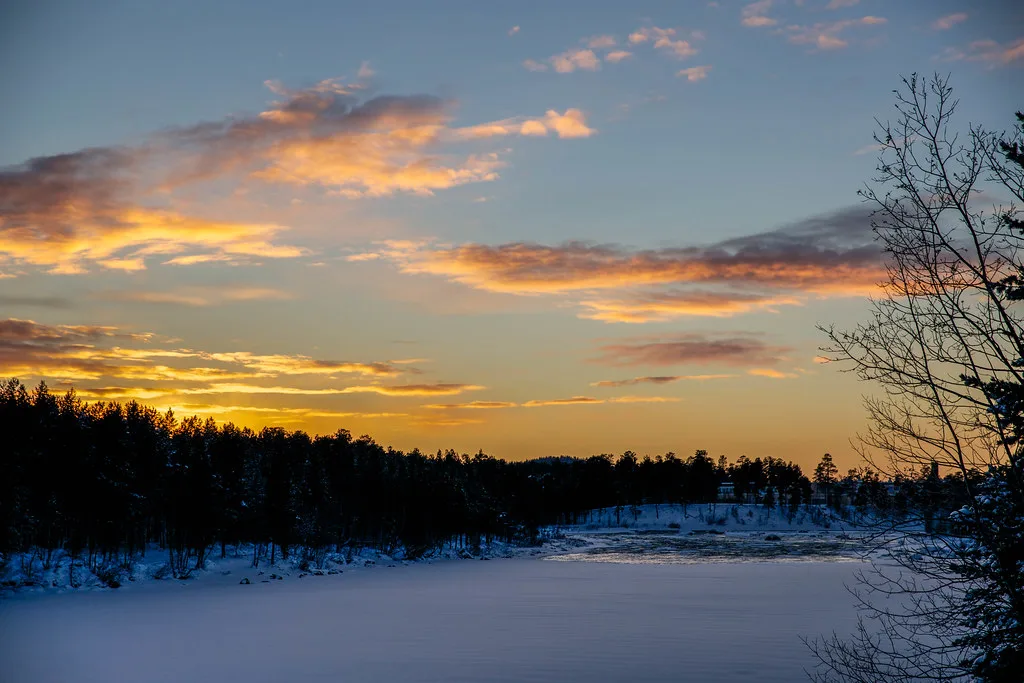
Along the Norwegian coast this produces a blue hour in the early afternoon, when the last indirect light reflects off sea and snow and the sky shades from pink and red in the south to deep blue in the north. Photographers treat that midday glow as the sightseeing window, not a setback. Plan outdoor activities for those few bright hours and save the darkness for aurora and dinners.
For travelers, the practical consequence is that a polar night trip still has a usable day. You can ski on floodlit runs, visit a husky kennel or drive between villages in the twilight, then be out under dark sky by mid-afternoon. The adjustment is psychological more than logistical: meals, excursions and sleep shift earlier, and the afternoons feel like evenings.
How latitude sets the length
Latitude decides how long the sun stays down. The duration grows by roughly six days for each degree of latitude you move north, which works out to about one month at 68°N and around three and a half months at 78°N. That rule is the single best tool for choosing a base: a resort a couple of degrees further north can add weeks of true polar night to your dates.
Europe's far north spans a wide band of latitudes, so the experience differs sharply between destinations. Northern Norway, Svalbard and the northernmost parts of Finnish and Swedish Lapland sit deep inside the zone, while Reykjavik lies south of the Arctic Circle and never gets a true polar night. Iceland still has very short midwinter days, and those dark hours are what aurora trips there rely on. If you want the sun genuinely below the horizon all day, look at bases above roughly 68°N.
Where polar night falls in northern Europe
The published date ranges for Norwegian sites show how the season stretches with latitude. At North Cape the sun stays down from 20 November to 22 January, at Vardø from 23 November to 19 January, and at Tromsø from 27 November to 15 January. Further south the window narrows: Harstad runs 2 December to 10 January and Bodø only 16 December to 30 December.
Finnish and Swedish Lapland sit at comparable latitudes, so their northern villages pass through the same weeks of sunless days. The Finnish term for the season is kaamos, and it frames winter tourism across the region. For a comparison of bases, latitudes and aurora access across all three countries, the guide to the best places to see northern lights sets out how the destinations differ.
Iceland is the outlier. Reykjavik lies just south of the Arctic Circle, so the capital never experiences a true polar night, though December days there are short enough that aurora hunting starts in the late afternoon. Travelers who want the full sunless-day experience should book Finnish Lapland rather than Iceland, and treat Iceland as a dark-season aurora destination instead.
Blue hour and midday colour
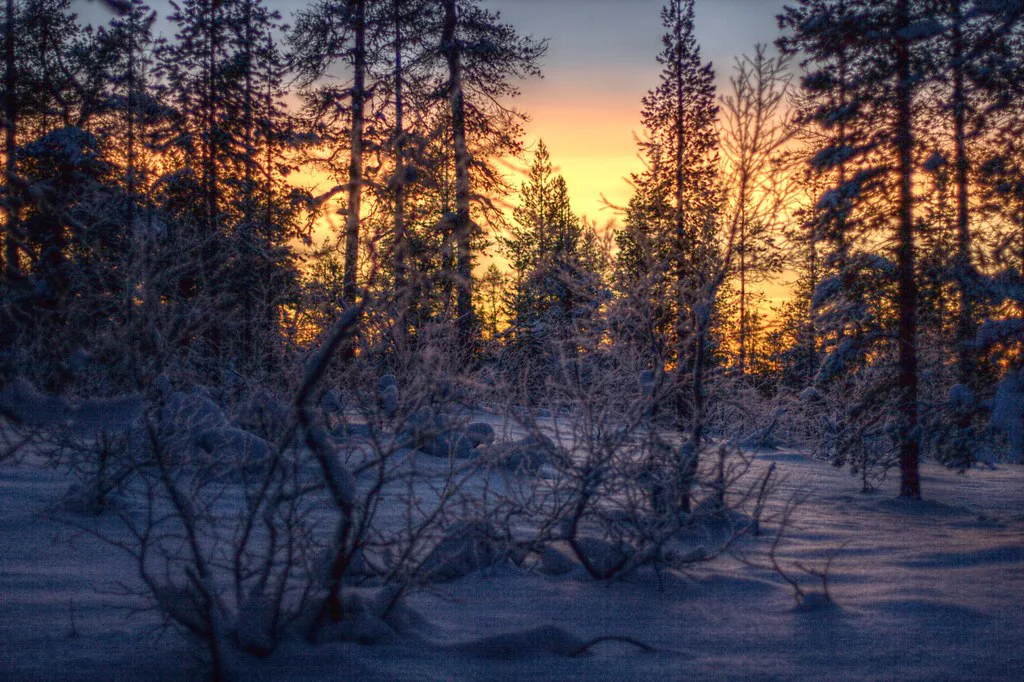
The blue hour, or blåtimen, arrives in the early afternoon during polar night and is the visual signature of the season. Low indirect light catches the sea and snow and washes the landscape in blue, while the southern sky can turn yellow, orange and pink. It is the best window for landscape photography and for any activity that needs you to see the terrain.
Because the sun never climbs high, shadows stay long and soft all day, which flatters snow and ice. Photographers often find the light more forgiving than the harsh spring sun, and the combination of a coloured sky with stars overhead is unique to these weeks. Build your itinerary around a late-morning start and a midday outing, then let the afternoon fade into aurora hours.
The aurora connection
Long nights raise the amount of dark sky available, but they do not guarantee a display. What matters is a geomagnetic disturbance plus clear sky, and cloud is the variable travelers can plan around by choosing inland bases, higher ground or a coast with a different weather pattern. Treat the planetary K-index as guidance only, and remember that a low Kp still produces aurora at high latitude. The explainer on what are the northern lights covers how solar activity drives displays and where in Arctic Europe they show.
Polar night concentrates the dark hours, so an aurora tour during those weeks can start in the early afternoon and still run for hours before midnight. Outside the strict polar night, in September and late March, you get longer usable days and still-dark nights, which many travelers prefer for combining daytime activities with evening chasing. Both windows sit inside the aurora season from roughly late August to early April.
How polar night overlaps the aurora season
The aurora season and the polar night are not the same thing. Aurora trips run from late August into early April because the nights are dark enough at both ends, while polar night is a shorter midwinter core inside that season. Booking in September or early April gives you more daylight and a lower chance of extreme cold; booking in December and January gives you the deepest darkness and the blue-hour midday.
The trade-off is simple. Midwinter dates maximize dark sky hours but shorten the sightseeing day and often bring the coldest temperatures. Shoulder dates keep more daylight for husky sledding, snowshoeing and village visits but reduce the number of dark hours per day. Either way, allow several nights, because weather patterns in the region rarely deliver a clear sky every night.
Finnish Lapland: bases inside the polar night
Finnish Lapland offers the most developed aurora infrastructure in Europe. Villages such as Saariselkä, Ivalo and Inari sit far enough north to pass through polar night, and the region's glass igloos, aurora cabins and wilderness hotels are built around evening viewing. Finnish Lapland is where you find the widest choice of heated viewing accommodation and short transfers to dark forest and fell terrain.
In practical terms, the Finnish bases put you within a short drive of national-park trails and open fell country where light pollution falls away quickly. Operators typically run evening minibus chases, snowmobile safaris and husky trips, and many lend thermal suits and boots on the night. Daytime in polar night is short but bright enough for a snowshoe loop or a reindeer visit, with the blue hour arriving early afternoon.
Swedish Lapland: how far north you need to go
Swedish Lapland works much like the Finnish side. Kiruna, Abisko and the villages around Torneträten sit above the Arctic Circle, and Abisko in particular is known for dark, dry skies in a rain shadow that often clears when the coast is clouded. That combination of latitude and local climate is what makes the area a serious aurora base rather than a scenic add-on.
If you want a true polar night, aim north of roughly 68°N: Kiruna and Abisko qualify, while bases near the Bothnian coast do not. The ice hotel tradition along the Torne River gives the region a distinctive winter stay, though most travelers combine one night of novelty with several nights in a cabin or hotel better suited to aurora watching. Snowmobile tours and dog-sledding run through the dark season.
Iceland: south of the Arctic Circle
Reykjavik sits south of the Arctic Circle, so the capital has no true polar night, only short midwinter days. That matters when you plan: aurora hunting in Iceland happens in the late afternoon and evening rather than under all-day darkness, and daytime excursions remain possible through December. Travelers who want sunless days should choose a Lapland base instead.
The upside is that Iceland combines aurora chasing with volcano country, hot springs and a road network that stays drivable in most winter conditions. The downside is more cloud, more wind and a longer drive to genuinely dark skies if you stay in the capital. Base yourself away from Reykjavik's light dome, or book a guided chase that drives out of it.
Daylight, cloud and temperature by month
Published figures for Norwegian sites illustrate the temperature range you are choosing between. Tromsø typically sits around -5°C to +2°C in winter, while Kirkenes often drops to -10°C or below, and wind chill makes both feel colder, especially at sea. Those numbers belong to the Norwegian coast; use them as a rough guide to how coastal and inland bases differ, not as a forecast for Lapland or Iceland.
Across the region, cloud cover is the biggest variable in any aurora plan. Inland and fell areas of Finnish and Swedish Lapland tend to have more clear nights than the Atlantic coast, while Iceland combines frequent cloud with strong winds. Winter temperatures inland commonly fall well below freezing, and the coldest weeks usually land in January and February. Check the national meteorological institute for your base before you fix dates.
Self-guided chasing versus a booked tour
Driving yourself gives you flexibility: you can leave when the sky clears, change direction mid-evening and stay out as long as you like. The costs are a winter-ready car, darkness driving on snow and the need to find dark spots yourself. In Finnish Lapland and Swedish Lapland the road network is manageable, but you should plan a loop that keeps several viewpoints within a short drive of your hotel.
A guided tour removes the driving and usually knows where the local cloud gaps are. Operators typically provide transport, a driver-guide and thermal suits, and often hot drinks and photography help, though what is included varies by company. For a first trip or a short stay, a tour on two or three nights is often better value than renting a car. For a longer stay with a confident driver, self-guided chasing wins on freedom. Either way, the guide to the Kp Index Explained will help you read the forecast without overreacting to it.
How many nights to allow
No one can promise a sighting. What you can control is the number of nights you spend under dark sky, and that number is the single biggest lever on your odds. Three nights gives you a fair chance if cloud is patchy; five to seven nights gives you room to absorb a cloudy spell, rest during the day and still come home with memories even if the aurora stays quiet. Travelers with aurora as the main goal should book at least four nights in one base.
Sights and stays for the dark season
The dark season has reshaped accommodation in the north. Glass igloos and aurora cabins put a warm room and a view of the sky in one place, but they trade privacy and sometimes heat control for the view, and light from inside can wash out a faint display. An ice hotel, reviewed in the guide to Ice Hotels in Europe, offers a night of novelty and photography rather than a serious aurora base; most guests spend only one night in the cold rooms.
For a longer stay, a cabin or small hotel outside the village lights often beats a novelty room. A sauna after a cold night out is part of the experience, and most Finnish and Swedish hotels include one. The roundup of Aurora Hotels in Europe points to stays where the view, the location and the dark sky are the point rather than an add-on.
Beyond the room, the region's winter sights are built for short days: husky kennels, reindeer farms, snowmobile trails and frozen lakes. Finnish Lapland also has national-park trails and fell scenery that stay accessible in the blue hour, while Swedish Lapland's Abisko area gives you a famous dark-sky viewpoint within walking distance of the village. Iceland's sights, from waterfalls to hot springs, are a drive away and often require a guided tour in winter.
Realistic trade-offs
Polar night is a compromise between darkness and daylight. You gain aurora hours and lose the long sightseeing day, which may not suit families with young children or travelers who want to hike and drive far. Cold is a real factor inland, where winter temperatures commonly fall well below freezing, and the cost of flights, transfers and aurora tours adds up quickly. A coastal or southern base in Iceland or Norway is milder but cloudier; an inland Lapland base is colder and clearer.
Light pollution is the easiest problem to solve. Towns and resorts have bright street and building lights, so choose a hotel on the edge of the village or a cabin with an open northern horizon. Glass igloos give you a view from bed but can suffer from internal glare and condensation; ask the hotel what the room includes before you book, and keep an eye on the Kp Index Explained if you want to interpret forecasts.
Where Norway fits as a comparison
Norway's northern coast offers the longest polar night windows in mainland Europe, with sunless weeks from late November through mid-January in Tromsø and longer still at the North Cape. Its coastal climate is milder than inland Lapland but often cloudier, and the cruise and coastal-express route is a different way to experience the dark season. Travelers comparing Norway with Lapland should weigh the warmer, wetter coast against the colder, clearer inland.
Svalbard goes furthest, with continuous darkness from late October to mid-February, and the experience there is genuinely extreme. That level of darkness is not for everyone, and it is far beyond what most travelers need. For most aurora trips, Finnish Lapland and Swedish Lapland offer a better balance of dark nights, winter activities and manageable cold. If you are weighing the Swedish side of that balance, this northern lights in Swedish Lapland guide compares the main bases, latitudes and aurora access.
Celebrating the sun's return
At the end of polar night, northern communities mark the return of the sun with Soldagen, when locals gather to greet the first rays and share solboller and hot chocolate. The sweet spiced buns, filled with vanilla custard, are the traditional food of the day. Travelers in the north in late January or early February can join the celebrations in towns that have just seen the sun again.
In Tromsø the local celebration uses solskinnsboller, vanilla buns named for the sunshine, and marks the moment the sun clears the mountains. The date varies by town because the surrounding terrain matters as much as latitude. If your trip overlaps the return of the sun, ask your hotel which day the town celebrates and where people gather.
Plan Your Visit
Polar night is best treated as a window, not a guarantee. Choose a base north of roughly 68°N if you want sunless days, allow at least four nights under dark sky, and plan your outdoor activities around the blue hour rather than fighting the short day. Finnish Lapland offers the widest choice of aurora accommodation, Swedish Lapland's Abisko area gives you a dark-sky classic, and Iceland works as a dark-season aurora trip rather than a polar night one.
Before booking, confirm the practical details for your chosen operator and the national meteorological institute forecast for your base, since tour inclusions and conditions change by season. Then let the darkness do its work: a clear night, a quiet road and time on your side are what turn a polar night trip into an aurora one.
Frequently Asked Questions
Which countries have polar night?
Polar night occurs inside the Arctic Circle, so in Europe it covers northern Norway including Svalbard, the northernmost parts of Finnish Lapland and Swedish Lapland, and the far north of Russia. Iceland lies almost entirely south of the Arctic Circle, so Reykjavik and the rest of the country have short midwinter days but no true polar night. Latitude decides the rest: the sun stays down for about a month at 68°N and far longer as you move toward the pole.
How long does polar night last?
Duration depends on latitude rather than country. The sunless period grows by roughly six days for each degree of latitude, which gives about one month at 68°N and around three and a half months at 78°N. On the Norwegian coast, North Cape runs from 20 November to 22 January while Bodø manages only 16 December to 30 December. A Lapland village a degree or two further north than your alternative can add weeks of true polar night to your dates.
Is polar night completely dark?
No. The sun stays below the horizon all day, but that does not mean round-the-clock blackness. Around midday the sky passes through twilight and the blue hour, when indirect light catches snow and sea and the southern horizon can glow pink, orange or yellow. Photographers treat that window as the sightseeing part of the day, and stars can still be visible overhead. Plan outdoor activities for those few bright hours and leave the darker afternoon for aurora.
Can you see the northern lights during polar night?
You can, but a sighting depends on geomagnetic activity and clear sky rather than darkness alone. Polar night concentrates the dark hours, which is why aurora tours run through those weeks and can start in the early afternoon. Inland and fell areas of Finnish and Swedish Lapland tend to have more clear nights than the Atlantic coast. Book several nights in one base and treat the Kp index as guidance only.
How many nights should you plan for a chance of clear skies?
Aim for at least four nights in one base if the aurora is the main reason for the trip. Three nights gives a fair chance when cloud is patchy, while five to seven lets you absorb a cloudy spell and still use the days for husky, snowmobile or sauna time. Because cloud is the variable you can plan around, more nights in one place beats moving between bases every day.
Why does Iceland not have a true polar night?
Reykjavik sits just south of the Arctic Circle, so the sun rises at least briefly even at midwinter. That means Iceland has very short December days rather than a sunless period, and aurora hunting happens in the late afternoon and evening instead of under all-day darkness. The country still works well as a dark-season aurora destination, with the trade-off of frequent cloud and wind. For sunless days, choose a Lapland base north of roughly 68°N.
Sources
Notes for your Arctic winter trip
Optional updates to our northern lights guides.
You might also like
Continue reading
More guides you'll find useful